Featured
......................
Categories
- Blocks (3)
- Brief (6)
- Computational Wood (1)
- Joinery logic (3)
- Paper (4)
- Peripherals (3)
- Summit (3)
- Uncategorized (15)
Dr. Herb Smokler teaches us how to husband and harvest Computational Wood. This mockumentary is the final installment of Matt Cottam’s Masters Thesis. The concept of Computational Wood evolved out of a workshop with Timo Arnall, Matt Jones, Jack Schulze, Adam Greenfield, and Lennart Andersson.
The Pairs swatches consist of 6 Ash dovetail joints with embedded electronics. Each of the six sets of Pin and Tail is identical (except in grain) in form and function–they differ only in the surface patina. Each Pair is treated in a unique way that gives it age and experience: one was put in the ocean for a month; one was divided between my wife and I–she wrote all over hers when she was missing me and I stained mine with tea and wine when I was away from her; one was chewed by our dog Bruno; one was distressed in a sandblaster; one was stained with iron and vinegar; and one was left perfect. The electronics allow the Pin and Tail of each dovetail to communicate wirelessly and by rechargable battery power. The halves chirp in patterns of call and response to each other when they are apart, they vibrate and chirp faster when they are near one another, and they are silent when connected.
Here I am putting a Pair (Ash dovetail joint with carcasses for electronics) into the ocean. I wrapped it in steel wire and bound it to a staircase at a dock in Newport, RI. Hoping for a naturally weathered patina.
Maia Garau shot the video and drove me home soaking wet.
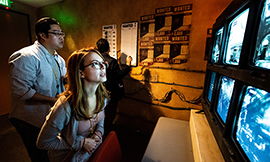
In March of 2009 Timo Arnall, Lennart Andersson, Matt Cottam, Adam Greenfield, Matt Jones, Jack Schulze and Mikael Wiberg spent a day lecturing at “Spring Summit 09:Sensing and Sensuality” and another day ideating around Cottam’s Masters Thesis. At the end of the ideation workshop, Jack and Matt J. present the findings and ideas from the conversation and sketching. Timo shot the video and chimes in from behind the camera and Cottam makes an appearance at the end.
This video was shot in January of 2009 during an intensive working session at Umeå Institute of Design. The short clip shows the process of preparing Birch veneer for laser cutting test-strips and the burning of wooden letter blocks for an Augmented Reality (AR) spelling game. The video was shot by Matt Cottam and was edited by James Hsu.
During our ideation day Lennart Andersson threw out a concept: What if you could grow wood that could be a conductor? What if you watered a tree with conductive ink one year, waited a year or two, then watered again with conductive ink, then waited… could the tree rings be conductor, insulator, conductor?
So I set out to make a “tap” (kind of like a maple syrup tree tap) that one could insert into a predrilled hole in a tree. The sections of the tap would contact the conductive growth rings in the tree. Then electronics could take power, ground and signal from the three rings. You could also harvest the wood and potentially “tap” a wooden table top and mount a lamp or electronic hardware.
This is the “far out scifi” concept in the bunch and very little thought has gone into (or will likely go into) making a system like this actually work.
I am now scripting a short video where we will tap some wood in a forest nearby. I have built out a whole toolbag for the Computational Wood forestry worker.
Video coming soon.
thanks to Ryan Coyle (RISD student) who helped me out in the metal shop.
Timo Arnall shot and edited this video of me working in the UID shops. Thank you Timo.
On the 28th of March 2009, Matt Jones, Timo Arnall, Jack Schulze, Adam Greenfield, Lennart Andersson, Mikael Wiberg and I spent a day talking about my masters thesis project. Many inspirational ideas were shared until late in the evening. Excellent fun in the shops, at the whiteboard and of course at the laser cutter.
These photos are all from Timo Arnall’s Flickr stream.
Jack Schulze, Adam Greenfield and I
I brief the team on the topic of the day
Jones wears Schulze
I present an array of objects that represent various qualities
Timo’s first burn
Adam is seduced by Lillypad
Polaroid Swinger as good plastic
Wood
Considering shop attack
Birch in the milling machine
Adam’s first burn: NYC visualization on burl veneer
Adam and Mikael appreciate the partial through burn
We unpacked wood+electronic project by RISD students
Jones’ notebook
Jones’ first burn
Timo’s Flickr upload activity laser cut on birch
As part of my research work towards a masters thesis at Umeå Institute of Design, I lead in the organization of a one day conference in Sweden. Speakers are listed on the poster below. I owe many thanks to the school and its staff and students for their support as well as to Tellart for partially sponsoring the event.
Poster was designed by Pierre-Alexander Poirier
Here also are a few images from Timo Arnall’s Flickr stream. Thank you Timo.
Conference motion graphics by Mikko
Jack Schulze
Schulze drawings
Schulze shows work done with Timo for the Touch Project
Adam Greenfield
Matt Jones shows off gifts made by students
Schulze’ bendy city maps
Greenfield and Rahul Sen (student MC)
Thanks to everyone who participated. Looking forward to next year’s event.
Starting to embed the sensing and computers
Light gate switch
Light gate with motise and tenon, Arduino Mini Pro, and Lilypad Vibe
Slider embedded in dovetail
Slider and dovetail assembly
Slider and milled wood
Slider and dovetail assembly with electronics
Slider and dovetail assembly with electronics detail
Final Assembly
For flex sensing I ripped and milled birch to 1mm thickness and created laminations - both with clamps and a vacuum bag. The first attempt failed but the second works well.
Laser etched and cut inlay of sensor
Homemade plywood
Layers
Glue up
Broken first try
Broken first try
Try 2: birch and cork in a vacuum bag
In hand pump vacuum bag
Birch + Cork + Flex sensor
Working
In this set I embed a linear touch potentiometer in cork and wood using a laser cutter and the woodshop.
Touch pot with fabric cord
Touch pot with cork cusion and laser cut wood block enclosure/lamination
Glued up and seamless - works with Arduino